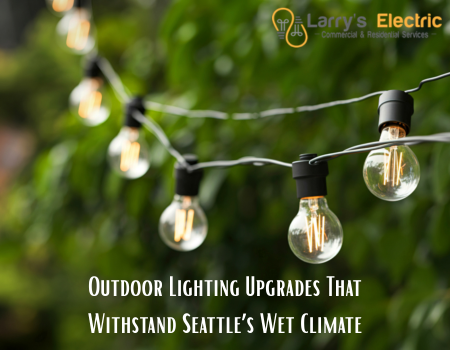
Seattle doesn’t do dramatic weather. No ice storms, no real freezes, nothing that makes the news. What it does is drizzle on you for nine months straight until everything that was supposed to keep moisture out has quietly given up. Outdoor electrical for outdoor lighting is usually the last thing people think about and the first thing that shows it.
The problem isn’t really the rain. It’s the dampness that never fully leaves — the fog off the Sound, the condensation that builds up inside a fixture housing at night and has nowhere to go by morning. Standard outdoor lighting is built for normal climates. Occasional rain, dry summers, humidity that behaves itself. None of that describes a west-facing wall in Ballard in February, and the stuff installed on those walls needs to actually be rated for what it’s dealing with.
Outdoor Lighting Upgrades That Withstand Seattle’s Wet Climate
GFCI Protection
This is where most older Seattle homes fall short without the homeowner knowing it. A ground fault circuit interrupter cuts power the instant it detects current going somewhere unexpected — which in a wet environment is the exact failure you’re trying to head off. Water finds its way in. It always does. A functioning GFCI is what keeps that from turning into a shock hazard or worse. Homes built before the 1980s often have no GFCI protection on outdoor circuits at all.
Not unusual, just how things were built back then.
What’s more surprising is how many homes from the 90s have GFCI outlets that haven’t been tested in years and wouldn’t actually trip if they needed to. The button on the outlet isn’t decorative — it needs to be tested periodically, and if it doesn’t reset cleanly, the outlet needs replacing. Current code requires GFCI protection on all outdoor circuits, but code only applies when the work was done. Whatever was there when you moved in is grandfathered in, working or not.
Weatherproof Outdoor Lighting Fixtures
There are two ratings that matter and people mix them up constantly: damp location and wet location. Damp-rated fixtures handle humidity and indirect moisture fine. Wet-rated fixtures are sealed against direct rain and standing water. A covered porch might get away with damp-rated. An exposed fixture on the back corner of the house absolutely won’t. The distinction doesn’t always show up clearly on packaging, and plenty of fixtures sold as “outdoor” are only damp-rated.
Two years in, those fixtures start failing — housing cracks, water gets into the socket, corrosion starts inside the fixture itself. Look for the UL wet location listing specifically. If it isn’t printed on the fixture or the box, assume it isn’t rated for it. Seattle’s outdoor lighting environment isn’t aggressive in a dramatic way, but it is relentless, and relentless is what cheap ratings can’t handle long-term.
Corrosion Prevention for Outdoor Lighting
This one is slower and harder to see coming. It’s the junction box on the side of the house nobody has opened in twelve years, quietly rusting where the mounting screws go through the bracket. It’s the wire nuts inside turning green, losing grip on the connection. Corroded connections create resistance. Resistance creates heat. That’s not a dramatic failure mode — it’s a slow one, inside a box that looks completely fine from the outside until it isn’t.
Aluminum and stainless hardware hold up in this climate making them a great choice for outdoor lighting. Standard steel doesn’t, not long-term. Solid brass fixtures look good and genuinely last. Thin chrome finishes, exposed iron, plastic that isn’t UV-stabilized — all of it degrades faster here than the packaging suggests. The freeze-thaw cycles Seattle gets are mild but real, and brittle plastic housings don’t survive them indefinitely. If the fixtures on your house are more than ten years old and nobody’s checked the hardware since installation, it’s worth opening things up and looking at what’s actually in there.
Where to Start With Outdoor Lighting
Most homeowners have no idea what’s actually inside their outdoor junction boxes. Corrosion building for a decade, GFCI outlets that stopped working reliably years ago, damp-rated fixtures doing the job of wet-rated ones because nobody checked the rating when they were installed. None of it is visible from the outside. A quick inspection before winter hits is worth more than people think.
Seattle is quiet about the damage it does to outdoor electrical — steady, slow, invisible until something fails or a breaker won’t reset. Getting ahead of it isn’t complicated. It’s mostly just knowing what to look for and not assuming that because something was working last summer, it’s actually in good shape.